Friction Loss Calculator

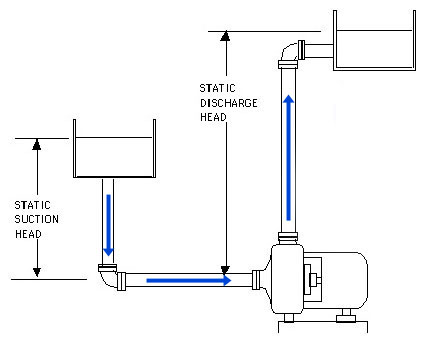
static discharge head

Friction loss is the loss of energy or “head” that occurs in pipe flow due to viscous effects generated by the surface of the pipe. Friction Loss is considered as a “major loss”.

“Head” is a very convenient term in the pumping business. Pressure is not as convenient a term because the amount of pressure that the pump will deliver is dependent upon the weight (specific gravity) of the liquid being pumped and as you know, the specific gravity changes with the fluid temperature and concentration.

Each litre of liquid has weight so we can easily calculate the kilograms per minute being pumped. Head or height is measure in meters so if we multiply these two together we get kilogram meters per minute which converts directly to work at the rate of 610 kgM/min = 1 kilowatt.

Please note that we always measure from the center-line of the pump impeller to the highest liquid level.

Estimate friction loss through straight pipe, valves and fittings. Enter your flow rate, liquid viscosity and pipe details, then add the quantity of each fitting in your pipeline.

1. Flow & pipe details

Use the actual internal diameter, not the nominal pipe size. Enter the viscosity for your liquid at its operating temperature.

Average velocity— m/s
Reynolds number—
Darcy friction factor—
Flow regime—
View converted inputs
Flow rate— m³/s
Kinematic viscosity— m²/s
Internal diameter— m
Absolute roughness— m

2. Valves & fittings

Enter a quantity for each fitting. Leave unused fittings at zero. Losses are shown in metres.

FittingQtyLoss (m)
—
—
—
—
—
—
—
—
FittingQtyLoss (m)
—
—
—
—
—
—
—
—

3. Friction loss results

Loss in valves & fittings— m
Loss in straight pipe— m
Total pipeline friction loss— m

This is friction loss only. Static elevation, required outlet pressure and other system losses must also be considered when selecting a pump.

Calculation method & assumptions

Uses Darcy–Weisbach for straight-pipe loss, 64/Re for laminar flow below Re 2,000, and the Swamee–Jain approximation for turbulent flow at Re 4,000 and above. Pipe and total losses are not reported in the transitional range.

Assumes a full, circular pipe carrying a Newtonian liquid. Fitting losses use K × V²/(2g), with g = 9.81 m/s². Pipe roughness values and fitting coefficients are retained from the previous All-Pumps calculator and are indicative; actual values depend on condition, geometry and valve position. Confirm suitability for your application with All-Pumps.

Shopping Cart
Scroll to Top